8.14.2012

GBBD - August 2012

Gardening in Santa Fe is a mixed blessing. The average rainfall is 14.22 inches. However, Santa Fe has an average of 283 sunny days. The soil can be rocky, sandy or clay. Last year I hardly planted anything because there was a severe drought. Sometimes, I plant three plants and only one or two plants overwinter. Planting odd numbers has rarely worked for me for this reason. However, this month I'm going to count the blessings in my garden.

I'm joining Garden Bloggers' Bloom Day. Special thanks to Carol at May Dreams Gardens for hosting. Please check out what's blooming in other parts of the country and in other parts of the world.
About twelve years, the view outside the window of my office was of a courtyard dotted with red yucca (hesperaloe parviflora). However, it seemed too large to put in my garden so that thought entered the recesses of my mind. Last year Susan at Ink & Penstemon blogged about a dwarf hesperaloe that would be the plant to have this year, Brakelights(R) red yucca. I don't know if it was the power of suggestion, but I planted three in my garden this spring. A month or so after planting, aphids covered the blooms on all three plants. I cut all the blooms off and forgot about it. One of the plants rebloomed recently with nary an aphid.
I've had this gaura in my garden for while. It came in a set of three. Only one survived, but for the first time ever it reseeded and now I have another gaura that is doing well in the garden.
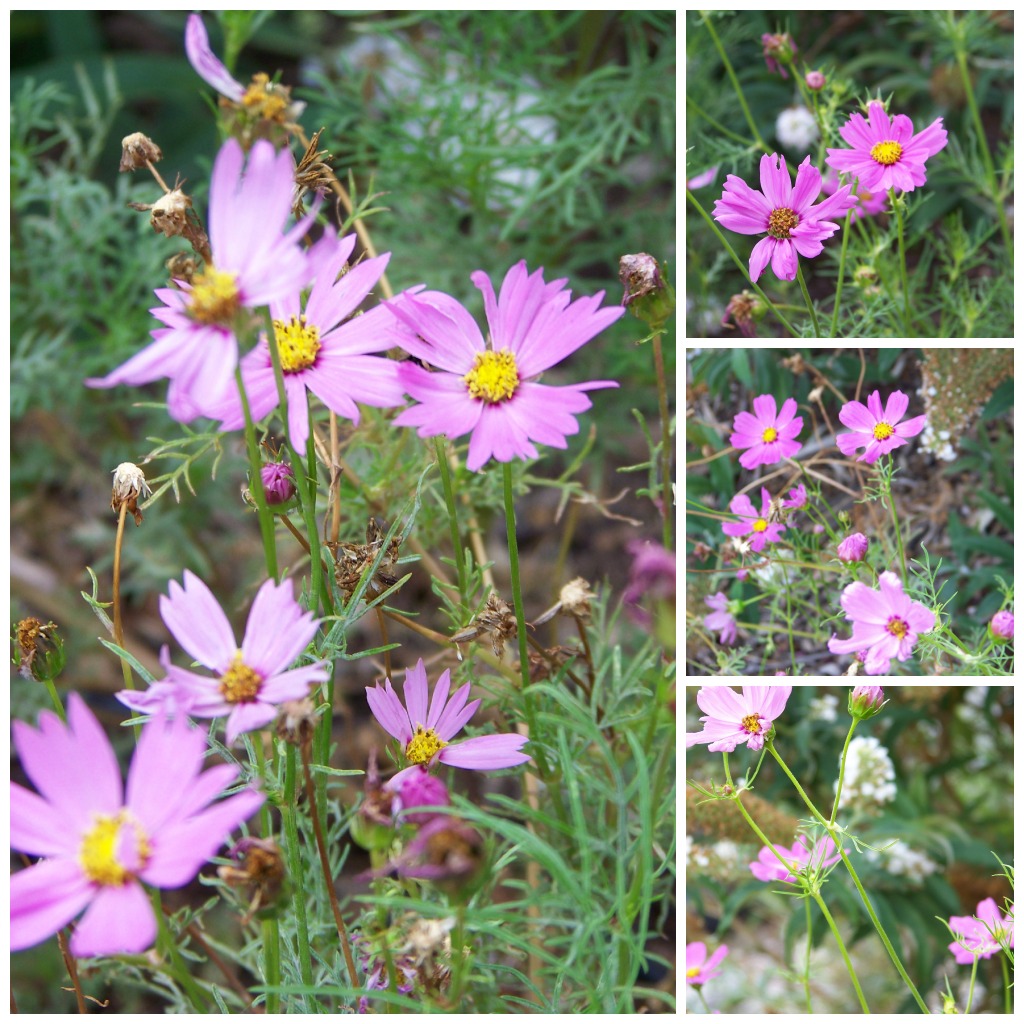
These might be the saddest cosmos of all time, but I started them from seed this spring and they're still going. I'm hoping they'll reseed and I won't have to plant cosmos next year.
I planted this desert four o'clock about three summers ago. It's one of the more xeric plants in my garden. Last week the four foot plus wide plant was covered in blossoms.
It's a sea o' licorice mint (agastache rupestris). I've tried other cultivars, but none does as well as the rupestris. I can count on it from year to year to provide soft waves of color in the waning days of summer.
My last blessing is plants overwintering. Plants don't reliably come back in the spring. I had a phantom drip emitter that wasn't attached to a plant so I plugged the end. The xeric desert asters came back where the drip emitter had been plugged. It is not as finicky and doesn't need as much water as traditional asters. I also planted the blue blazes agastache last year and wasn't sure what to expect. Woohoo, all three plants came back.

What blessings are you thankful for in your garden this year?

8.12.2012

Almost Free Plants

This post was supposed to be entitled "Free Plants." Alas, a clearance sale got the better of me. Two weeks ago today, I received an email from Santa Fe Greenhouses, the flagship store of the online nursery High Country Gardens stating that perennials were 60% off because they are closing for the summer after August 26th. (I hope they're are only closing for the summer and not for good since it's my favorite nursery.)
I went shopping during my lunch break. When I arrived, the parking lot was already full so I parked on the street. As I entered the nursery, I saw that the line to pay went out the sliding glass doors and about 30 feet to the left to the entrance of one of the greenhouses. I almost made a hasty exit because the queue to pay was so long, but I didn't. I made my way around the perennial tables and found a plant or two or three or....
Walker's Low catmint (nepeta) is one my favorites. Catmint can drive gardeners crazy because of its propensity to reseed EVERYWHERE. Walker's Low is a non-reseeding cultivar. It blooms in the spring and fall if the flowers are deadheaded. I don't always deadhead in spring, but I usually will have fall blooms nonetheless. I also got some more silver edged horehound (marrubium rotundifolium). 
I went looking for some Pat Vlasto sage (salvia jamensis), but to no avail and ended up with some Prairie Sage (salvia azurea). I also got a row cover and some seaweed fertilizer. Aside from the perennials being 60% off, the garden supplies were 40% off. Everything was free because I had two gift cards and belong to the waterwise gardeners' club and had points that I could redeem towards purchases. Yea for gift cards from my friends who know that I'm obsessed with plants.
Last Friday, I received another email that the plants had been replenished. Maybe, there were some plants that I couldn't live without. I haven't been gardening much this summer so I thought I would pop over for a look-see. I still had a small balance on my gift card and points from the previous week's purchases so my whopping total for four plants was about $1.86. 
Well this Friday, when I came into the office my supervisor showed me the Santa Fe Greenhouses advertisement in the local paper and perennials were 70% off! Gallon plants that are usually $10.99 were $3.30. So I loaded up with Flore Pleno poppies and Blue Lips penstemon and a salvia, gaura, and spirea thrown in for good measure. I have three plants left to plant from my shopping spree(s): a Black Cherry salvia, the spirea and a White Swan echinacea. However, I did spend money today, $31.81 on plants and sundry garden supplies. However, on all three of my shopping trips I saved around $126. Hooray for summer clearance sales.

7.25.2012

Fibonacci in Flowers

This post is an excuse to show some photos of my white swan echinacea. Feel free to skip the text and look at the photos.
I'm not a math nerd. I think I struggled through calculus in high school and I know I struggled through geometry. Geometry made complete sense to me until one fateful day when I was helping a classmate study for a test. The next day I completely blanked out on the exam and my friend got an "A." Since then math has never been the same for me.
Nonetheless, it not's hard to be intrigued by patterns in nature that are a result of math. The Fibonacci Sequence is a series of numbers: 0, 1, 1, 2, 3, 5, 8, 13, 21, 34 .... Each number is the sum of the previous two.

0+1=1
1+1=2
1+2=3
2+3=5
3+5=8
5+8=13
8+13=21
This sequence is pervasive in nature in the spirals that form seed heads, in pine cones, and cauliflower. If you look at a the bottom of a  pine cone or at a seed head, you will see that the spirals go clockwise and counterclockwise.
Source: Wikipedia Commons - Alvesgaspar
There are 21 clockwise blue spirals and 13 counterclockwise aqua spirals. 21 and 13 are two numbers in the sequence. This pattern allows the density of the seeds on the head to be uniform without overcrowding in the middle or sparseness along the edges. Pretty cool, huh?
Look at the spirals the next time you see a sunflower or echinacea. Who knew math could be so fun? Do you know of other examples of the Fibonacci sequence in nature?

Lagniappe

7.22.2012

Kitchen Garden A to Z

A local bookstore in Santa Fe, Garcia Street Books has two bargain tables outside that I can't help rummaging through. One of the books I purchased there this Spring about vegetable gardening was Kitchen Garden A to Z: Growing Harvesting, Buying and Storing by Mike McGrath.
Kitchen Garden A to Z
It's a coffee table book for beginning vegetable gardeners. There are four sections:
  • Kitchen Garden Basics,
  • Tools of the Trade,
  • The Cycle of Life, and
  • The Kitchen Garden A to Z
square foot garden
Kitchen Garden Basics gives an overview of raised beds, composting, companion planting, natural pest and weed control, and containers. The overviews are brief, which I appreciated. I especially liked the summary of composting. It gave enough information without overwhelming a newbie vegetable gardener with too many details. The Tool of the Trade, and the Cycle of Life sections are similarly structured. I might even try making my own seed starting mix next year with the recipe provided in this book. 
lemon cucumbers on makeshift tuteur
The meat of the book is the Kitchen Garden A to Z section. The book starts with artichokes and ends with zucchini. I loved the layout of this section. It devotes a two page spread to most of the plants. (Tomatoes have a four page spread.) The left page has two columns: the first is a photo collage of the plant and the second column provides an overview of the plant with the following headings: scientific name, types, growing tips, harvest, buying, storage, and tricks. It also footnotes what each of the photos are in the collage. The right page is a full page photo of the plant. 
zucchini gone wild
The trick it mentions about zucchini is, "You do not have to choose between the delicious edible squash blossom flowers and fabulous fruit. There is a golden moment when the baby fruits have just become big enough to eat and the flowers is still attached and in good shape." (p. 158)
Roma tomatoes
Even though it is a coffee table book, it is not devoid of useful information. I find myself reading this book before I go to sleep. It includes growing tips for herbs, non-traditional vegetables like kohlrabi and edible flowers. Some readers might find this book scant on detail, but it was enough for me. Please note this book is out of print. However, you can find it online at used book resellers. 
Brandywine tomato
I'm joining Holley's monthly Garden Book Review meme.  Special thanks to Holley at Roses and Other Gardening Joys for hosting. Please check out what other garden bloggers are reading.

7.14.2012

GBBD - July 2012

My perennial bed in the backyard seems to be half overgrown and half barren. There is a periphery of flowers now and the agastache rupestris are starting their bloom cycle.
Last summer, I had one sad salvia pachyphylla, "Blue Flame" bloom. It's my favorite salvia in my garden. High Country Gardens states in the Spring 2012 catalog, it's "A finicky plant for experienced gardeners." That definitely leaves me out. 
Last summer was dry dry dry. Did I mention it was dry? However, my three plants have gotten lots of supplemental water this year because it's connected to the same drip system as my vegetable garden. I need to start a new drip zone for the vegetables with a separate timer, but for the time being they're receiving the benefit of more water. What a difference a little water makes.
I don't think they're as xeric as they're purported to be. A friend of mine planted one last year and hers is gargantuan. She doesn't do anything special, but water and feed it.
I probably shouldn't have gone crazy with the salvia photos, but I'm not sure when I'll have so many flowers again.  
This week I was able to turn off the timer for the drip system and didn't need to water because of some monsoonal rains. The ground was moist in the mornings and in the afternoons I heard the tapping of raindrops on the windows in my office.
These firecracker penstemon (eatonii?) have gotten overgrown and are ready to be divided. They've been long lived in my garden, which is something I can't say for many of my penstemon.
The Shasta daisies are faring well with extra water, too. I probably shouldn't have them in my garden, but I planted them when I was still trying to fit a square peg in a round hole in terms of gardening. I wanted a traditional perennial border that doesn't lend itself to gardening in Santa Fe. They don't bloom often, but I don't have the heart to pull them out. So are you receiving extra rain this year or is it as dry as a bone where you live?

I hope you enjoyed the little tour of the back garden. I'm joining Garden Bloggers' Bloom Day. Special thanks to Carol at May Dreams Gardens for hosting. Please check out what's blooming in other parts of the country and in other parts of the world.

7.09.2012

Apricot Mojitos

It's been hard to get back into the swing of blogging. I was on vacation last week during the Fourth of July holiday.

Before I left I was inundated with apricots and now I'm inundated with rotting apricots that my dog, Aster has mostly ignored. Unless, she has a stronger constitution than most dogs overeating fruit. I've been trying to get them picked up before she decides they're tasty morsels. 

The Thursday before my vacation, I picked as many as I could and brought most of them to work for my co-workers. The few I saved I made an apricot crisp with a recipe I found in Sunset magazine.
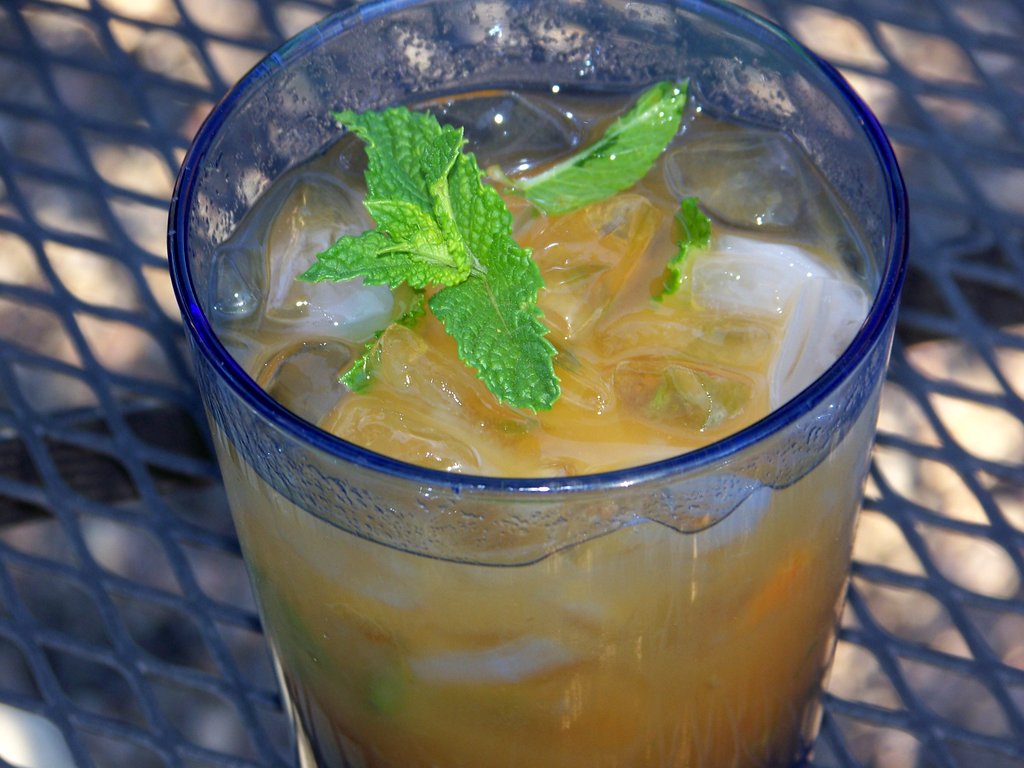
In addition to the apricot crisp recipe, I also tried making apricot mojitos. It's my personal twist on the refreshing lime and mint Cuban cocktail. 
Apricot Mojito
1 oz of brandy (less or more to taste)
3 small apricots or 1 store bought apricot
12 mint leaves
2 wedges of lemon
4 oz of club soda
sugar or simple syrup to taste

Muddle ripe apricots, brandy, and mint leaves. I use a mortar and pestle. Pour over a glass full of ice. Add club soda, sugar or simple syrup to taste. Squeeze juice from lemon wedges and stir. I wish I'd had the time to can or freeze the apricots before I went on vacation. However, the apricots mojitos were a yummy pre-vacation cocktail to start my summer fun at the beach. Cheers!


6.24.2012

Apricots Galore

I don't have the expectation that there will be any fruit on my apricot tree. In the 10 or so years that I've lived in my house, the apricot tree fruited once. Although the tree is planted in my yard about a third of the tree's limbs hang over on Lucille's, my neighbor's yard. Lucille had commented that the last time the tree fruited, she had picked about a handful of fruit or enough to make an apricot cobbler. I had picked about two handfuls of fruit that year. Needless to say, it wasn't a bumper crop.  
That same year, you could drive down Agua Fria Street and see people pulling over to pluck apricots. There is a row of apricot trees on one side of the street that is not flanking any houses. The sidewalk was littered with them. Alas, my house was not littered with them that year. 
Due to intermittent warming and freezing in winter and spring, I haven't had any apricots in six or seven years. The apricot tree has gotten unwieldy and I have considered chopping it down. This year the tree had lots of blossoms, but there was another freeze. I assumed, the tree would not bear fruit and mostly forgot about it. One day my neighbor stopped me as I pulled into the driveway from work. She asked if, "I noticed the fruit on our apricot tree?" I had, but only a single or pair of fruit here and there. 

Nothing had prepared me for this year's bounty. When I arrived home from work on Friday, there were apricots scattered all over the ground in the backyard. I started gathering them with the hope that they wouldn't entice my dog, Aster. I called my neighbor and left a message about the apricots falling and put a tarp over the ground so they wouldn't be damaged falling from the tree. 
After overindulging in freshly picked apricots Friday night, I've been zealously looking up apricot recipes. The first recipe I tried is for an Apricot Clafouti. The recipe I used is for a Cherry Clafouti from the Joy of Baking. A clafouti is a custard like dessert from the Limousin region of France and is traditionally made with cherries. I chose this recipe over others because it only required 20 minutes of baking. It was simple to make for a non-baker like myself and served four. Changes I might make the next time are: add some brandy or other liqueur, add lemon zest, and a pinch more salt for the batter.

I hope everyone has a bumper crop of something this year. Who knew I would have so many apricots? I'm joining the "Garden To Table Challenge" hosted by Wendy at Greenish Thumb. Check out what other gardeners are cooking from their gardens this week. 
Related Posts Plugin for WordPress, Blogger...